
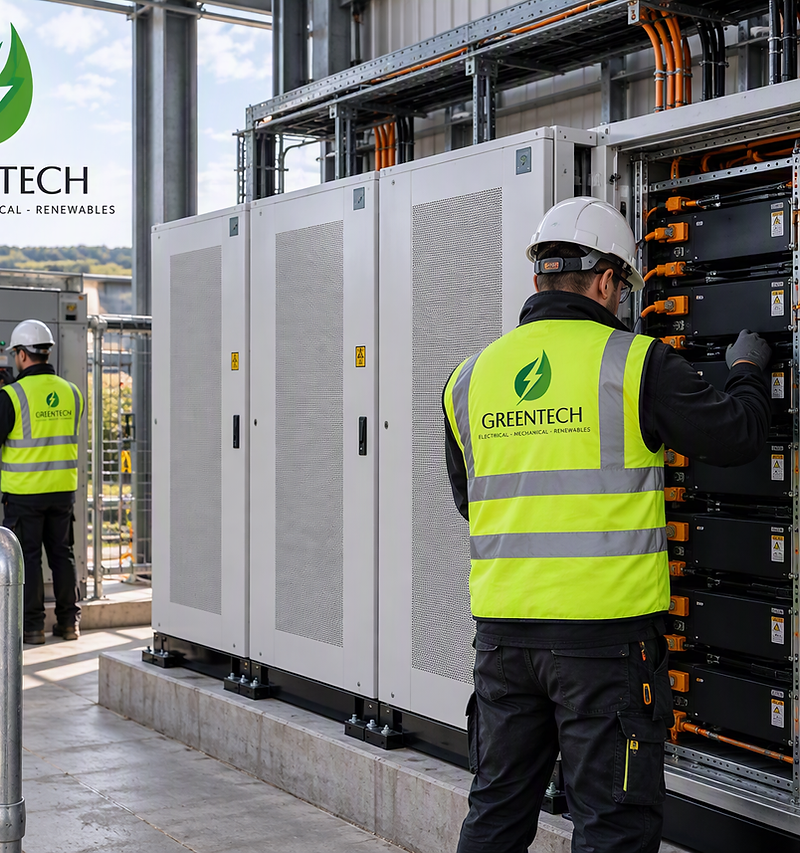
Battery energy storage
Battery storage that earns its place in the electrical design, not just the energy strategy
Storage is an electrical installation before it is an energy strategy. Siting, protection, ventilation, fire strategy and network approval all have to be right before the commercial case can stand up.
We design and deliver commercial and industrial battery systems as part of the wider electrical infrastructure — standalone, or paired with solar PV and EV charging.
- Connection
- G99 applications managed
- Integration
- Protection, isolation and metering
- Lifecycle
- Condition reporting through RCR
The position
Storage earns its place when it is designed into the electrical system — siting, protection, fire strategy and network approval settled before the commercial case is presented.
What storage projects underestimate
Storage is often specified as a box to be bolted onto an existing supply, with the electrical consequences worked out afterwards. Import limits, protection coordination and the physical location are then renegotiated mid-project.
A storage system that cannot be operated within the site's existing supply limits has not solved the commercial problem it was bought for.
What that looks like on site
- No review of the existing supply capacity and protection before sizing.
- Fire strategy and insurance requirements considered late.
- No plan for how the asset will be inspected and maintained over its life.
What we deliver
Scope of works
The boundaries matter as much as the content. If something sits outside our scope, we say so before the project starts.
- 01
Feasibility and sizing
Load profile analysis to establish what storage can actually shift, and whether the return comes from peak reduction, resilience or export.
- 02
Network approval
DNO engagement and application for the import and export position the system requires.
- 03
Electrical integration
Connection design, protection coordination, isolation and metering integrated with the existing distribution.
- 04
Civil and siting
Compound or plant room requirements, containment, ventilation and fire separation working with your building team.
- 05
Commissioning
Functional testing, control strategy commissioning and handover documentation.
- 06
Lifecycle support
Maintenance and condition reporting as the asset ages, including systems delivered by others.
Project anatomy
A storage project is an electrical project first
The battery is one component. The design work sits in what connects it to the site, and what the site is allowed to import and export.
- 01
Load and tariff profile
What the site can shift, and what the value of shifting it actually is.
- 02
Import and export capacity
Existing supply reviewed, with DNO engagement where the limits change.
- 03
Protection and isolation
Coordination with the existing distribution, plus isolation and metering.
- 04
Siting and fire strategy
Compound or plant room, ventilation and separation agreed with the building.
- 05
Controls and commissioning
Operating strategy commissioned and handed over with documentation.
Routes in
Where you might be starting from
The right first step depends on whether this is a new project, an asset already installed, or an adjacent requirement.
- 01
Battery storage project
Sizing, network approval, electrical integration and commissioning.
Discuss storage - 02
Solar and storage together
Generation and storage designed as one system rather than two purchases.
Commercial solar - 03
Storage and EV demand
Charging load managed within the supply headroom storage creates.
EV infrastructure - 04
Existing battery asset
Condition, documentation and degradation reviewed under RCR.
RCR for commercial assets
Process
How the project runs
- 1
Assess
Half-hourly data, supply capacity, protection study and physical siting constraints.
- 2
Design
System sizing against the value it can actually deliver, integrated into the electrical design.
- 3
Deliver
Electrical, civil and control works coordinated with the site and the network operator.
- 4
Protect
Maintenance regime and condition reporting agreed at handover, not left until something fails.
Standards
What this work is measured against
The standards and certifications that govern the work, and the basis on which we expect to be held.
- BS 7671
- Electrical installation and protection of the storage connection.
- G99
- Connection application where the system affects export or import limits.
- Manufacturer requirements
- Installation and commissioning to the equipment manufacturer's specification, with certification retained.
- Site fire strategy
- Siting and separation agreed with the building's fire strategy and insurer requirements.
Considerations
What tends to go wrong
Being explicit about risk is more useful than promising that nothing will happen.
Import limits
Charging capacity is frequently constrained by the existing supply. That has to shape the design from day one.
Tariff dependency
A business case built on one tariff structure is fragile. We model more than the best case.
Long-term visibility
Storage loses capacity quietly. Periodic condition reporting keeps you ahead of it.

Evidence
No published project for this scope yet
Rather than present a project from another discipline as evidence, we have left it out. Ask us directly for references relevant to your requirement.
Greentech RCR
Existing battery asset?
RCR covers battery storage condition as part of a wider renewable asset review, including systems installed under another contractor.
Domestic RCR
£149 + VAT
Commercial RCR
From £295 + VAT
Domestic RCR is £149 + VAT per property. Commercial RCR starts from £295 + VAT and is confirmed against the assets on site — never assumed.
The RCR siteRelated
Adjacent capability
Asset care
Greentech stays involved after handover: testing, maintenance and condition reporting for the assets we install and the assets we inherit.
Greentech RCRBattery storage
Discuss this with the team that delivers it
Tell us the site, the constraint and the timescale. If we are not the right contractor, we will tell you that too.