
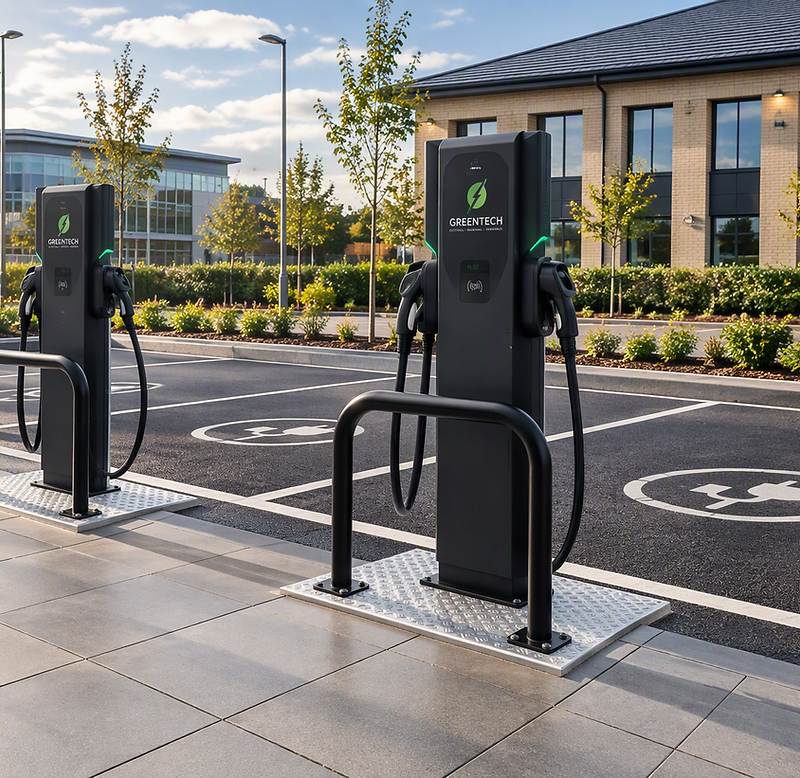
Commercial EV charging
Workplace and fleet charging that does not overload the building it serves
Charge points are the visible part. The design problem sits behind them: supply capacity, load management, cabling routes, protection and how the site will scale as demand grows.
We deliver commercial and fleet charging infrastructure as an electrical project, coordinated with your supply and, where relevant, with battery storage.
- First step
- Capacity study, before specification
- Design
- Load management designed in
- Delivery
- Civil, containment and commissioning
The position
Greentech delivers EV charging as commercial infrastructure: the charge points, the distribution behind them, and the capacity strategy that lets a site scale without a second excavation.
The capacity question comes first
A charge point installation added to a site with no spare capacity is a queue waiting to happen — or a supply upgrade nobody budgeted for.
The workable approach is to design for the load profile you will actually have, with load management and a phased route to more capacity later.
What that looks like on site
- Charge points specified without establishing available site capacity.
- Load management treated as an optional extra rather than part of the design.
- No provision for future bays, cable routes or containment.
What we deliver
Scope of works
The boundaries matter as much as the content. If something sits outside our scope, we say so before the project starts.
- 01
Capacity assessment
Review of the existing supply, distribution and spare capacity against the intended charging load.
- 02
Design and load management
Charge point selection, distribution design, and load balancing so charging fits within the supply you have.
- 03
Civil and containment
Ducting, bases, protection bollards and cable routes coordinated with the site layout and any groundworks.
- 04
Installation and commissioning
Mounting, connection, protection, testing, commissioning and back-office set-up.
- 05
Integration
Coordination with solar PV and battery storage so generation and charging work from one strategy.
- 06
Ongoing support
Inspection, fault attendance and condition reporting as the estate of charge points grows.
Charge point to supply
What sits between the charger and the building
The charge point is the last item in a chain. Every element below it decides whether the installation works at scale — and what it costs to extend later.
- 01
Vehicles and usage pattern
Dwell time, fleet movements and the charging profile the site will actually produce.
- 02
Supply capacity
Existing import reviewed before bays are committed, including any upgrade lead time.
- 03
Distribution and protection
Sub-mains, boards, RCD/RCBO arrangements and isolation for the charging estate.
- 04
Ducting, bases and civil
Cable routes, bases, bollards and reinstatement coordinated with the site layout.
- 05
Charge points and load management
Installation, back-office set-up and active control within the available supply.
Routes in
Where you might be starting from
The right first step depends on whether this is a new project, an asset already installed, or an adjacent requirement.
- 01
Workplace and fleet charging
A fully delivered commercial charging project, from capacity to commissioning.
Discuss EV infrastructure - 02
Solar, storage and charging
Generation, storage and charging designed as one energy strategy.
Commercial solar - 03
Charge point condition reporting
Protection, mounting, cabling and back-office status reviewed under RCR.
RCR for commercial assets - 04
Ongoing maintenance
Inspection, fault attendance and testing across an installed charging estate.
Maintenance & compliance
Process
How the project runs
- 1
Assess
Site capacity, parking layout, usage pattern and the phasing you actually need.
- 2
Design
A design that works within the existing supply, with a clear upgrade path.
- 3
Deliver
Installation sequenced around site operations and vehicle movements.
- 4
Operate
Commissioning, back-office set-up and a maintenance plan for the charge point estate.
Standards
What this work is measured against
The standards and certifications that govern the work, and the basis on which we expect to be held.
- BS 7671
- Electrical installation and protection, including the requirements specific to electric vehicle charging.
- IET Code of Practice
- Design and installation of electric vehicle charging installations.
- Load management
- Active load control to keep total site demand within the available supply.
- NICEIC
- Certification of the installation and its testing.
Considerations
What tends to go wrong
Being explicit about risk is more useful than promising that nothing will happen.
Future demand
The fleet electrifies faster than expected. Routes and containment planned once save a second excavation later.
Supply upgrades
If a supply upgrade is required, it has a lead time that must be built into the programme.
Cable routes
Long runs across car parks drive cost. Route planning is an early design decision, not a site one.

Evidence
No published project for this scope yet
Rather than present a project from another discipline as evidence, we have left it out. Ask us directly for references relevant to your requirement.
Greentech RCR
Charge points already installed?
RCR includes EV charging infrastructure condition alongside solar and storage, so a mixed estate is reported consistently.
Domestic RCR
£149 + VAT
Commercial RCR
From £295 + VAT
Domestic RCR is £149 + VAT per property. Commercial RCR starts from £295 + VAT and is confirmed against the assets on site — never assumed.
The RCR siteRelated
Adjacent capability
Asset care
Greentech stays involved after handover: testing, maintenance and condition reporting for the assets we install and the assets we inherit.
Greentech RCREV charging
Discuss this with the team that delivers it
Tell us the site, the constraint and the timescale. If we are not the right contractor, we will tell you that too.