

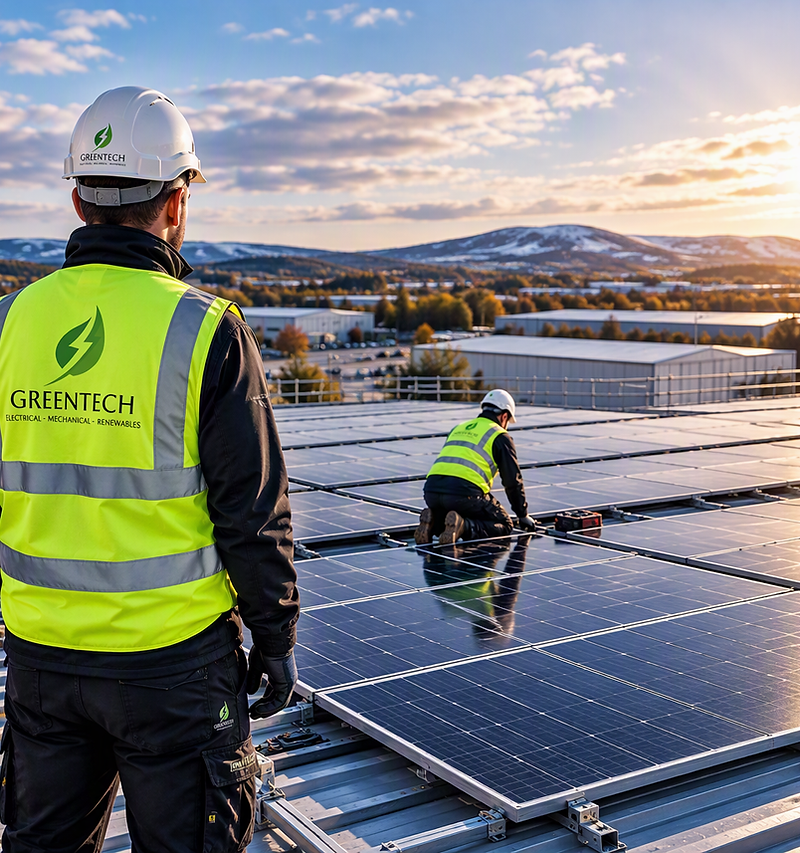
Commercial solar PV
Commercial solar PV that is modelled honestly, installed properly and reported on later
A commercial array is a twenty-five year asset. The business case has to survive contact with your actual consumption, your roof, your network connection and your board.
We size systems against real half-hourly demand, handle the DNO and G99 process, install and commission — and we can return years later to report on how the asset is actually performing.
- Certification
- MCS certified installation
- Connection
- G98 / G99 applications handled
- Existing arrays
- Assessed and reported under RCR
The position
Commercial solar is energy infrastructure, not a rooftop add-on. It changes the site's supply, protection, controls and reporting — and it has to work with how the building actually runs.
Why solar business cases get challenged
Most commercial solar proposals are built on generating more than the site can consume, at a yield borrowed from the south of England, with an export rate that assumes the best available tariff.
The system still works; the payback does not. The board then treats every future energy proposal with suspicion.
What that looks like on site
- Arrays sized to roof area rather than to the site's demand profile.
- Yield figures that do not reflect central Scotland's irradiance.
- Grid connection and export limitations discovered after the order is placed.
What we deliver
Scope of works
The boundaries matter as much as the content. If something sits outside our scope, we say so before the project starts.
- 01
Feasibility and modelling
Consumption analysis, roof and structural review, yield modelling and a payback model you can take to a board — with the assumptions shown.
- 02
System design
Array layout, mounting strategy for trapezoidal, standing seam and flat roofs, inverter selection and string design.
- 03
Grid connection
G98 and G99 applications, DNO liaison and approval management through to connection.
- 04
Installation and commissioning
Delivery around your operations, with commissioning, testing and certification, plus metering and monitoring set up.
- 05
Funding support
Documentation to support grant and loan applications, and the tax position set out before you commit.
- 06
Condition reporting later
Greentech RCR for existing arrays, including arrays we did not install.
Indicative modelling
What could your roof actually return?
Size an array against your own electricity use and roof area, and see the annual saving, payback and 25-year position it implies — before anyone quotes you a number.
Your site
Your total annual electricity bill, excluding standing charges.
Results are indicative, based on the assumptions entered and shown. They are subject to survey, structural assessment, metered energy data, network requirements, design and commercial review.
Indicative result
Cumulative return over 25 years
- Estimated annual generation
- 104,060 kWh
- Installed cost
- £94,380
- Year-one tax relief (AIA)
- − £23,595
- Net cost after tax relief
- £70,785
- CO₂ avoided per year
- 20.1 tonnes
- Gross savings over 25 years
- £824,808
Indicative only. Based on the assumptions entered and shown, and subject to survey, structural assessment, metered energy data, network requirements, design and commercial review.
Central Scotland yield, sizing to consumption and funding shown separately — the assumptions behind these figures.
See the full assumptionsSystem view
Designed against the building, not the roof area
We model the array against your demand, your connection and your electrical infrastructure. Where the roof or the network limits the design, we say so before an order is placed.
- 01
Demand and consumption
Half-hourly data reviewed to establish what the site can genuinely use.
- 02
Roof and structure
Covering, fixings and structural capacity reviewed as part of the survey.
- 03
Array and inverters
Layout, string design, inverter selection and monitoring.
- 04
Connection and protection
AC integration with the existing distribution, protection and metering.
- 05
Reporting across life
Commissioning evidence now, condition reporting as the asset ages.
Routes in
Where you might be starting from
The right first step depends on whether this is a new project, an asset already installed, or an adjacent requirement.
- 01
New commercial solar project
Feasibility, modelling, connection and delivery as one coordinated project.
Start a solar project - 02
Existing array assessment
A short indicative screening of an asset you already own.
Check an existing asset - 03
RCR condition report
Observed condition, findings and prioritised actions on the installed system.
Commercial RCR - 04
Remedials and upgrades
Defects, isolators, containment, monitoring and testing put right.
Maintenance & compliance - 05
Battery integration
Storage designed alongside generation where the site profile supports it.
Battery storage
Process
How the project runs
- 1
Assess
Energy data, roof condition, structural capacity and existing electrical infrastructure — before any yield number is quoted.
- 2
Design
Sizing against self-consumption, not roof area. Where the roof limits the array, we say so and look at car-port or ground mount.
- 3
Deliver
Installation sequenced with roof access, weather and site operations, with a named project manager throughout.
- 4
Verify
Commissioning evidence, then periodic condition reporting as the asset ages.
Standards
What this work is measured against
The standards and certifications that govern the work, and the basis on which we expect to be held.
- MCS
- Certified renewable installation, which also underpins scheme eligibility for many projects.
- NICEIC
- Electrical installation and connection works to BS 7671.
- G98 / G99
- Statutory notification and application to the distribution network operator.
- BS 7671
- Associated electrical infrastructure and protection.
Considerations
What tends to go wrong
Being explicit about risk is more useful than promising that nothing will happen.
Roof condition
Installing on a roof nearing end of life means paying twice. We review the roof as part of the survey, not after.
Export limits
Where the local network cannot accept export, the design has to shift towards self-consumption or storage.
Performance drift
Arrays degrade slowly, and so do joints, isolators and monitoring. Without periodic inspection you find out at failure.
Evidence
No published project for this scope yet
Rather than present a project from another discipline as evidence, we have left it out. Ask us directly for references relevant to your requirement.
Greentech RCR
Already have solar?
Greentech RCR provides structured condition reporting on existing PV arrays, including systems installed by others — with observed findings and the actions they call for.
Domestic RCR
£149 + VAT
Commercial RCR
From £295 + VAT
Domestic RCR is £149 + VAT per property. Commercial RCR starts from £295 + VAT and is confirmed against the assets on site — never assumed.
The RCR siteRelated
Adjacent capability
Asset care
Greentech stays involved after handover: testing, maintenance and condition reporting for the assets we install and the assets we inherit.
Greentech RCRCommercial solar PV
Discuss this with the team that delivers it
Tell us the site, the constraint and the timescale. If we are not the right contractor, we will tell you that too.